

Three evidence states, never blended
Detected, retest-confirmed and inconclusive stay separate on every finding.
Read the definitionsPoint LyraShield at a repository, URL or API you are authorized to test. It reviews what your coding agents shipped and returns one verdict: ready, not ready or insufficient evidence.
7 days · 60 agent-minutes · 3 targets · no card
Set up LyraShield in your coding agent →Open beta · Security review for AI-built apps. Evidence is limited to the authorized scope and the checks that ran. No security guarantee.
Four things stay visible so you can defend the decision to ship.
Detected, retest-confirmed and inconclusive stay separate on every finding.
Read the definitionsIf a check did not run or cannot prove a fix, the verdict says insufficient evidence instead of rounding up to a pass.
Fixes arrive as proposals. Nothing auto-merges. A connected coding agent acts only inside a grant you confirm in the browser.
The retest runs server-side from a clean baseline, so the conversation that wrote the patch never grades its own work. It confirms a fix only for a finding a deterministic scanner raised; one the model engine alone raised ends inconclusive.
Works alongside the scanners you already run. LyraShield adds evidence states, fix proposals and retests.
Passive and read-only
The free Lite Check above reviews exposed secrets, browser protections, frontend data-layer signals and HTTPS at the public URL you authorize. Here is how to read its results.
For checks that never leave your browser, use the WebMCP Security Checker or other browser-local tools.
What it covers / what it cannot proveA passive check reads what your app already exposes publicly. It can show you what is missing; it cannot prove that nothing is wrong. The deeper questions — auth flows, logic and whether a fix actually held — need the full loop. What the Lite Check covers and what it cannot prove
One finding, followed through the loop.
AI builds fast. LyraShield keeps what you checked, how you checked it and what changed after in one reviewable record instead of scattered chats and manual checks.
Example EX-014 · Authorized scope is stated
Review a repository, public URL or API. Use a passive Lite Check for a quick public-surface read or create an account for the full evidence loop.
Name your repo, live URL or API before anything runs. Nothing is tested outside the boundary you explicitly approve.
Example EX-014 · Target identity stays on record
Deterministic checks find known signals. AI-assisted review examines logic, auth flows and data handling. Separate coverage layers show what kind of evidence you actually have.
Example EX-014 · The checks that ran are recorded
The control ledger separates 43 code or URL review controls from 7 evidence-required controls. Unmatched or unsupported checks remain inconclusive, never silently passed.
43 review controls · 7 evidence-required
Detected, retest-confirmed and inconclusive remain distinct. Missing proof stays visible; it never becomes a silent pass.
Example EX-014 · Detected is distinct from proven
See which check produced the signal, whether independent proof exists and whether a fresh retest confirmed the change. Shared records omit repository coordinates and raw secrets.
Review a plain-English explanation and staged patch proposal. PR execution stays blocked until a server-generated patch is bound to your exact approval.
Example EX-014 · A proposal still needs approval
Use the hosted MCP server and supported agent integrations to inspect results and prepare approval-gated remediation without copying findings between tools.
A fresh, server-owned scan checks the fix. Complete deterministic coverage can confirm it; engine-only absence stays inconclusive.
Example EX-014 · Missing coverage stays inconclusive
Scope, coverage, findings, fixes, retest outcomes and limits become one checksum-bound launch report: a private snapshot written once per scan and report type, bound to a recorded sha256 manifest checksum. Shared versions exclude repository coordinates and raw secrets.
Example EX-014 · Scope and limitations travel with the report
Create a workspace, add the target you are shipping and choose the depth of review. LyraShield keeps the resulting scope, evidence and retest outcome together.
From the next decision to the recorded review. Choose a view to see how the workflow fits together.
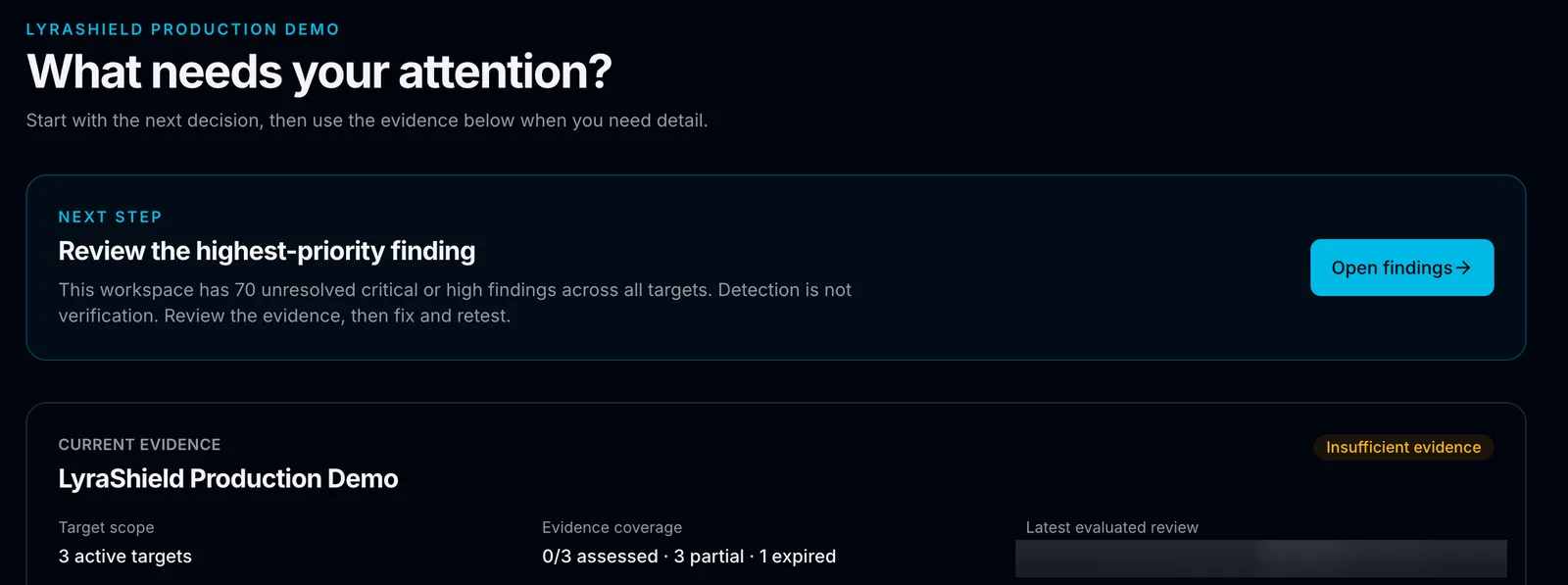
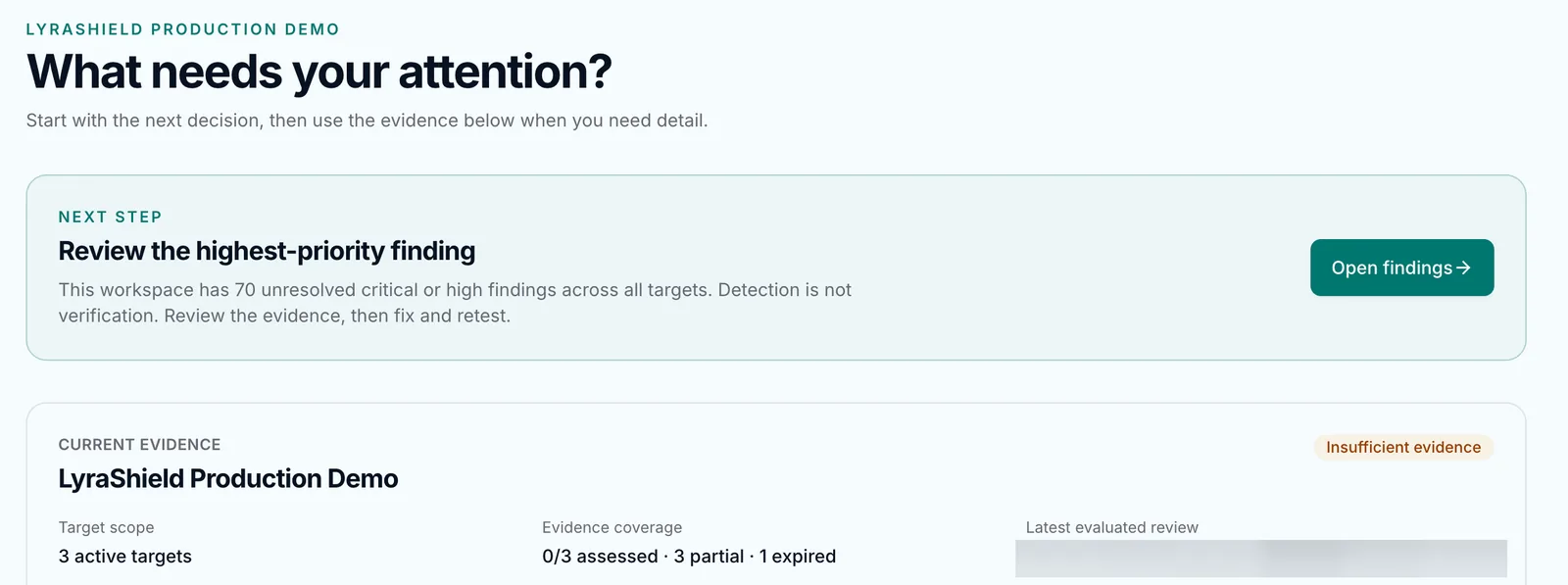
Start with one next action. Keep assessed scope, incomplete coverage and the current evidence state in view.
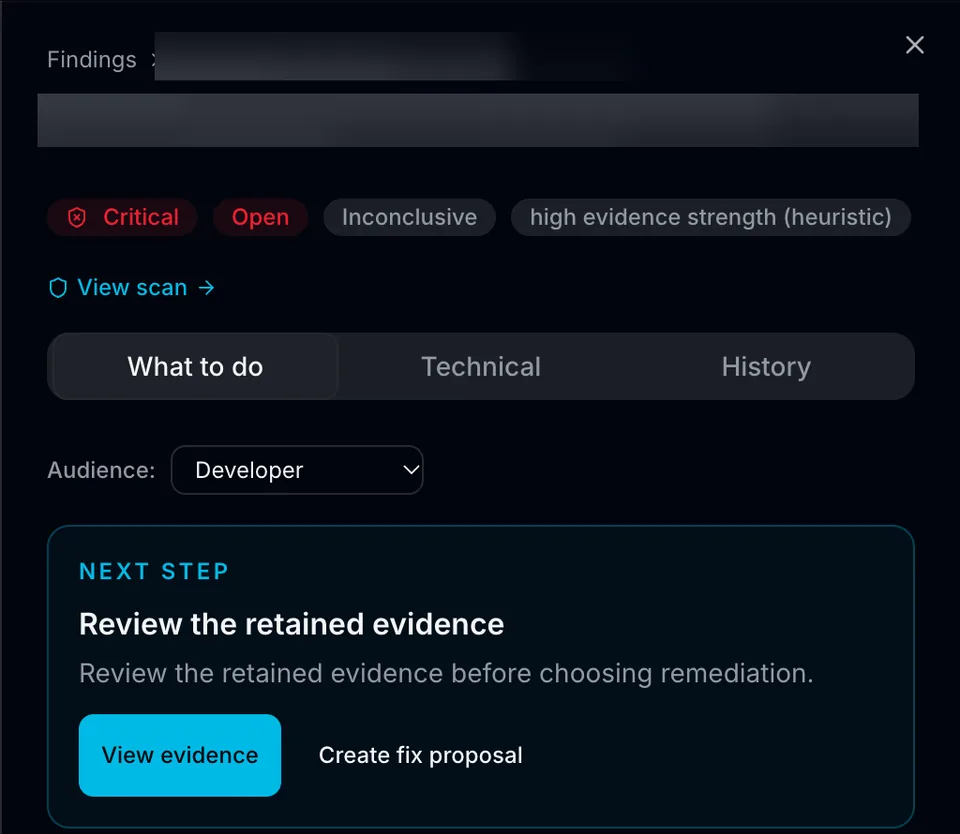
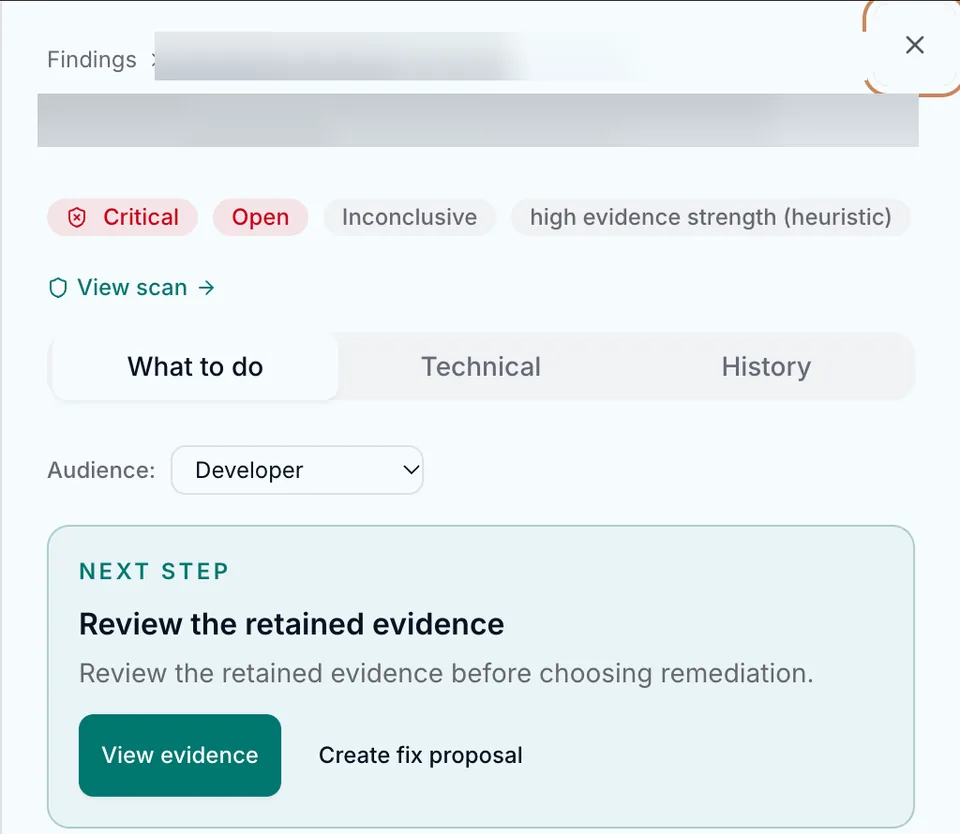
Severity, status and evidence state stay separate. The next step leads to retained evidence and an approval-gated fix proposal.
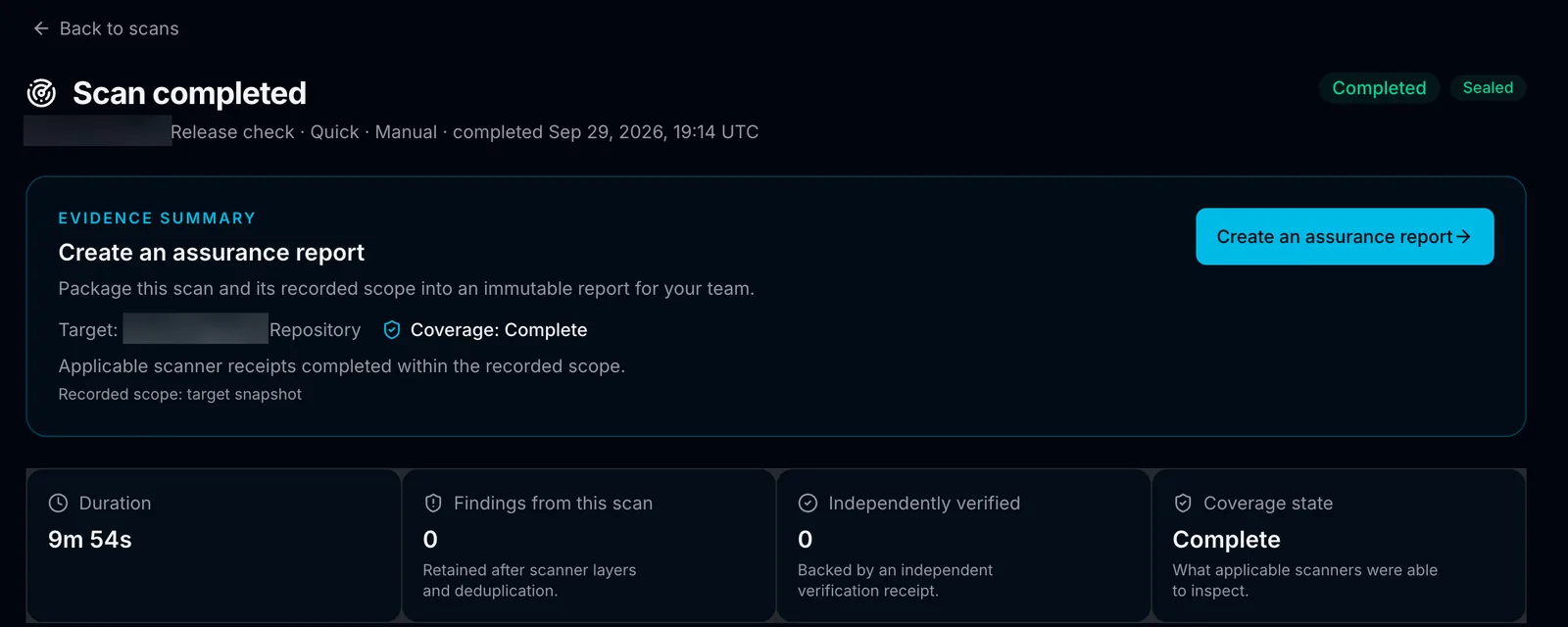
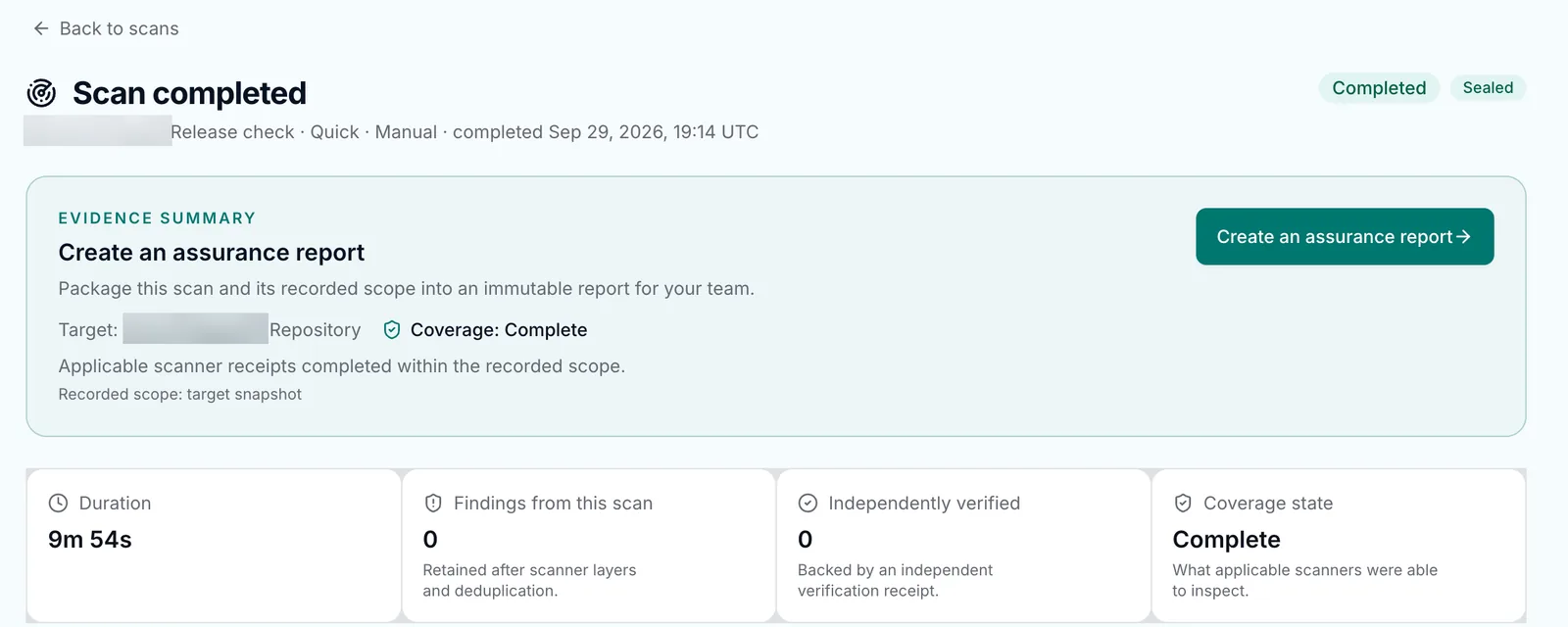
Keep scan completion, findings and coverage distinct when packaging the recorded scope for your team.
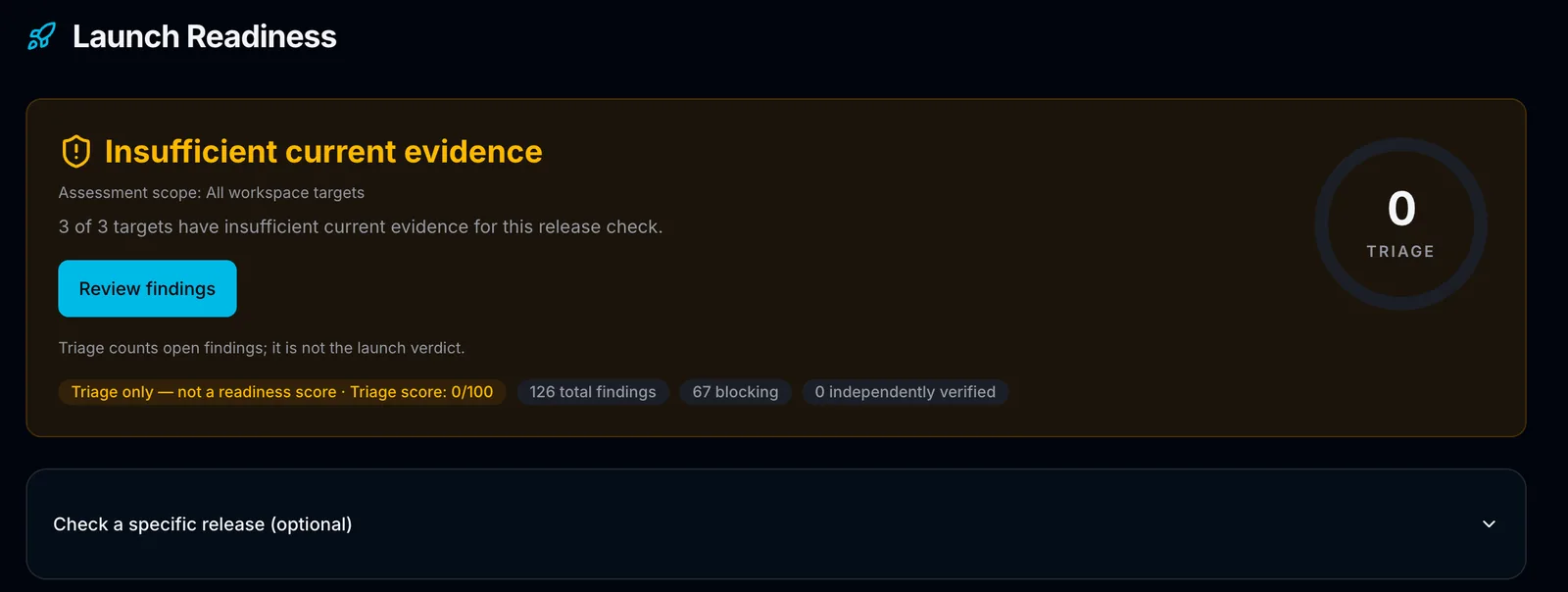
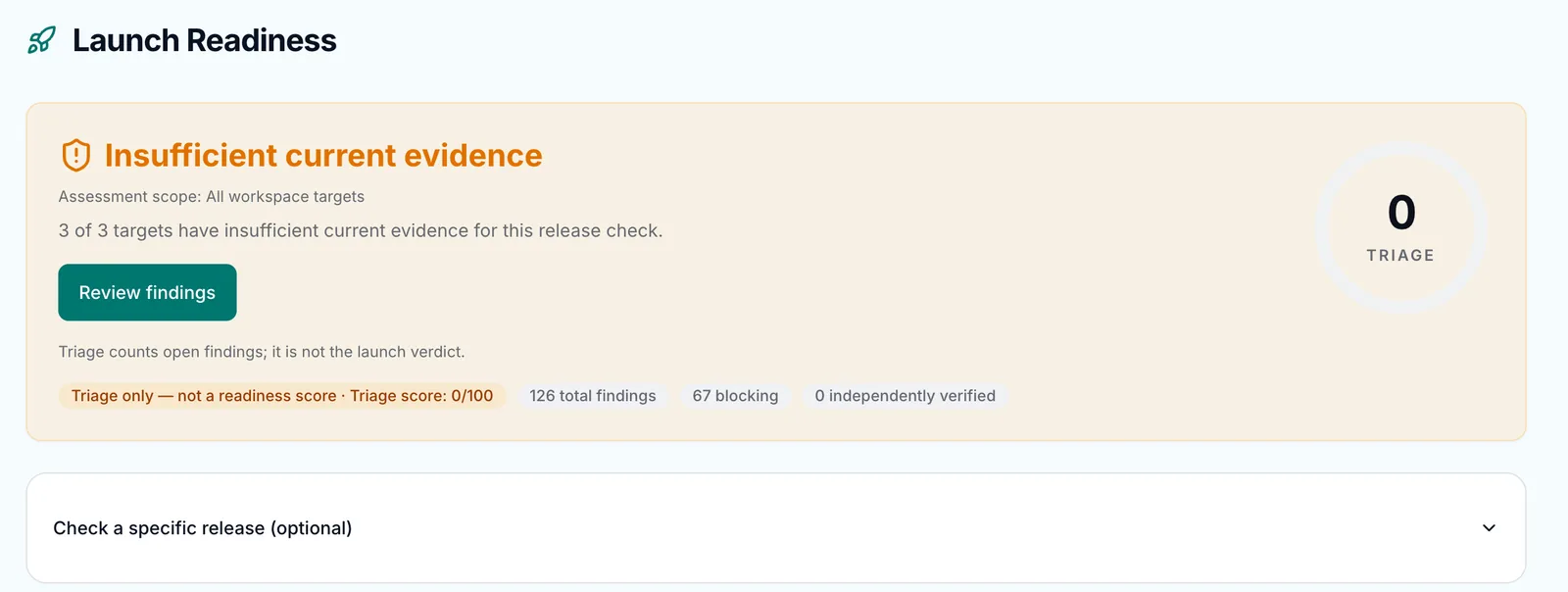
Readiness explains the evidence limits. Triage helps prioritize open findings without becoming a launch verdict.
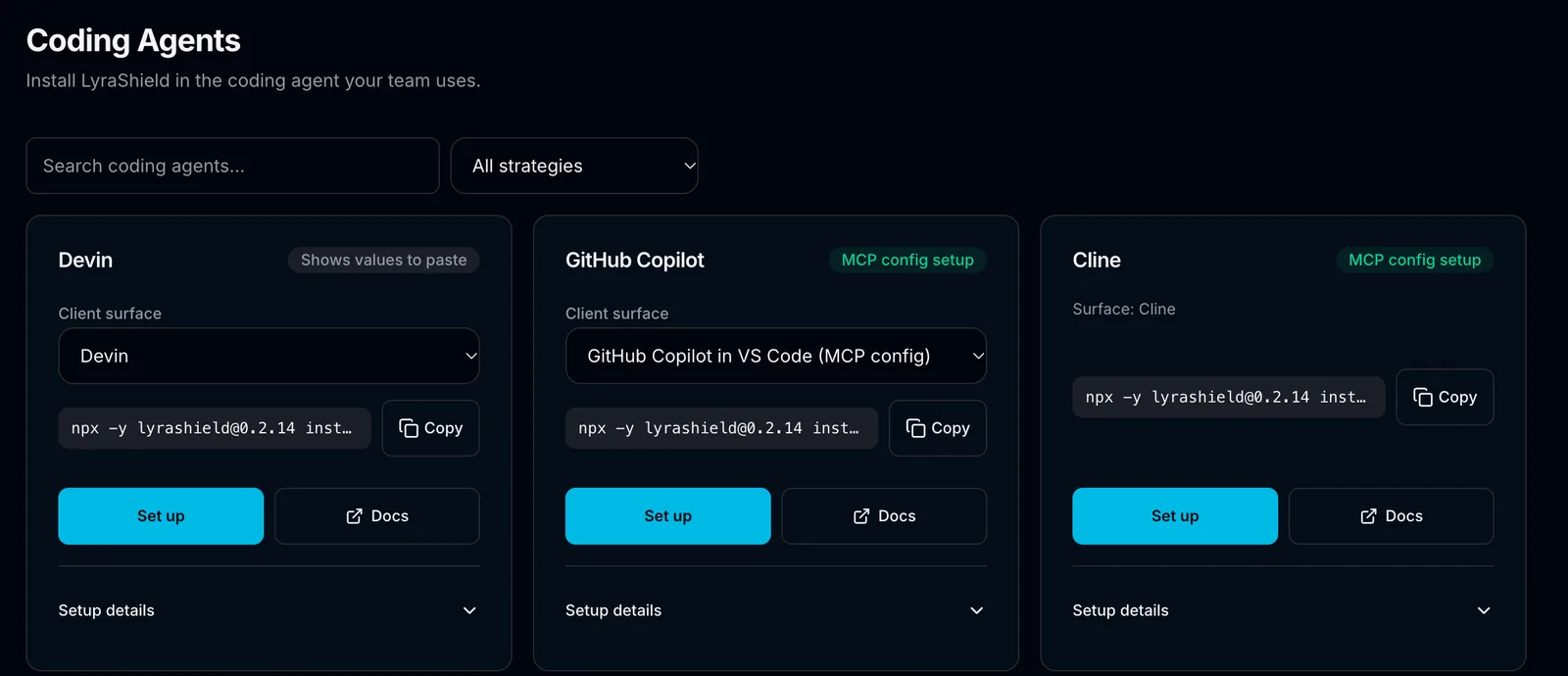
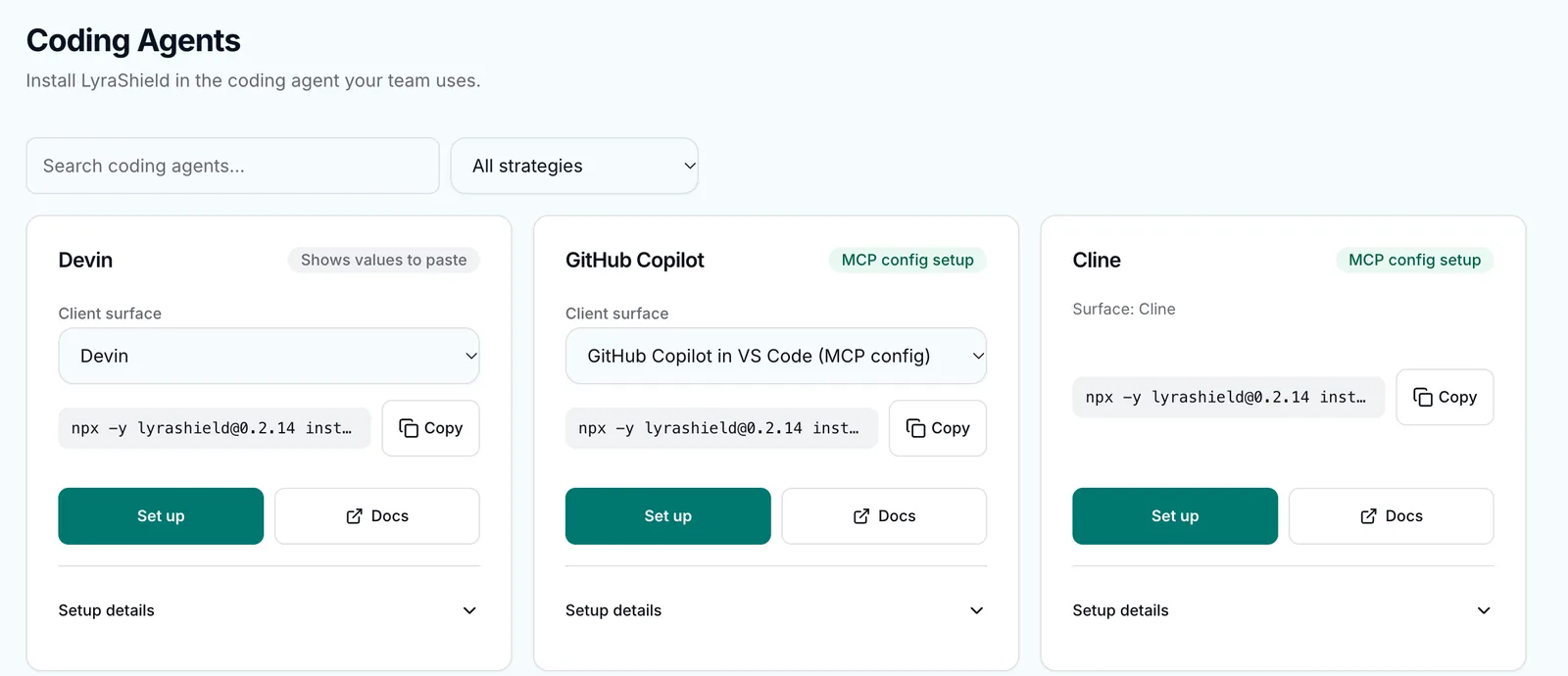
Find your client, choose its setup method and open the installation guidance. Technical setup details stay available when you need them.
Actual dashboard captures from the demo workspace, supplied on October 9, 2026. Private identities and finding details are redacted. Counts and evidence states describe the captured example.
The console keeps scope, coverage, findings and their evidence states, fix proposals and fresh retest outcomes together, so the release decision is reviewable rather than reconstructed.
Start a local workspace session from the command line.
npx --yes lyrashield@0.2.14 login --oauthThe installer pins the client version, so the command above is the one this site is built against.
Runs scan-level SARIF in GitHub repositories without a LyraShield account or API key, so a pull request gets a check before anyone signs up.
Read the GitHub Action guide48 documented client workflows. Your agent runs the checks and brings back evidence. Hosted writes still need a browser-confirmed grant.
Set up your coding agent43 are reviewed from code or a URL. The other 7 describe how you operate: audit coverage, monitoring, restore proof, deployment egress, test independence, multi-agent trust and accountable review. Those live in the Operational Evidence Vault.
Coverage version vibe-security-50/1.2.0. A clean result does not prove an application has no vulnerabilities.
Repository, URL and API reviews, agent-tool surfaces and an operational evidence record.
Dependency and secrets scanning in depth. LyraShield adds evidence states, fix proposals and retests rather than replacing them.
That an application has no vulnerabilities.
Cloud plans
Start with a free trial: 7 days · 60 agent-minutes · 3 targets · no card. Paid plans bill monthly or annually; regional prices and full limits are on pricing.
$29.00/mo
$295.00/yr210 agent-minutes/month ⓘup to 5 targets
For solo builders reviewing up to five targets with standard scans.
Safe, Quick and Standard scans.
Choose Starter$99.00/mo
$950.00/yr850 agent-minutes/month ⓘup to 15 targets
For solo builders who need Deep and Custom scans across up to 15 targets.
Deep and Custom scans included.
Choose Pro$499.00/mo
$4,188.00/yr4,500 agent-minutes/month ⓘup to 50 targets
For a team of up to five sharing one minute pool across up to 50 targets.
Deep and Custom scans included.
Choose AgencyEnterprise is contact-led from $1,500.00/month. Talk to us about custom limits and a contact-led rollout.
Create a workspace, add an authorized repository, public URL or API target, then choose the review depth. LyraShield keeps the resulting scope, findings, evidence states, fix proposals and fresh retest outcomes in one launch report.
Only what the retained evidence supports. We keep detected findings, retest-confirmed fixes, inconclusive retests and checks that were limited or not applicable distinct. Missing proof stays visible.
No. LyraShield records fix proposals and can stage a server-generated patch. Fix PRs open only after a human approves, with a server-generated patch. A connected OAuth agent may run only the operations authorized by its browser-confirmed grant, with checks at execution. Nothing auto-merges.
No. LyraShield complements specialist scanners rather than replacing them: SCA, secrets scanning, dependency checks and repo review are coverage layers inside a wider launch-gate workflow that adds evidence states, fix proposals and retests. Specialist tools may still provide deeper coverage in their own category.
It is a private workspace where you collect, review and version proof for the seven Vibe Security 50 controls that cannot be established by a repository or URL scan: audit trails, monitoring, backup tests, sandboxing, test independence, multi-agent trust and accountable review. Accepted evidence is frozen into a checksum-bound private assurance report; public shared reports do not include it.
Live today: the free Lite Check, 7 browser-local tools, the full launch-gate platform in open beta, the Operational Evidence Vault, MCP and GitHub integrations, a published CLI and a GitHub Action with a diff-aware gate and SARIF output. Registration is open; product pages describe current coverage and limits. Cloud prices and full limits are listed on /pricing.
Scans run in hardened, short-lived environments. The full platform retains scope, receipts, findings and evidence states, not a copy of your source. Shared reports exclude repository coordinates, file paths and raw secrets.
The Lite Check passively reads an authorized public URL for a bounded set of surface signals. The full platform can review repositories, URLs and APIs, retain control-level evidence, stage fix proposals, run fresh retests and produce a shareable launch report.
Target → review → evidence → retest
Create a workspace, add a target and choose the review depth. Nothing auto-merges and missing evidence stays visible.
Book a demo with the founder for a walkthrough.
Prefer to work from your coding agent? View agent setupLyraShield support
Myra · AI support
I'm Myra, LyraShield's AI support agent. I can explain the product, help with setup or connect you with a person.
I’ll use LyraShield guidance where I have it and help you reach support when I don’t.