
Detected candidate
A scanner found a signal worth reviewing. Confidence can help prioritize it, but does not prove exploitability.
Methodology
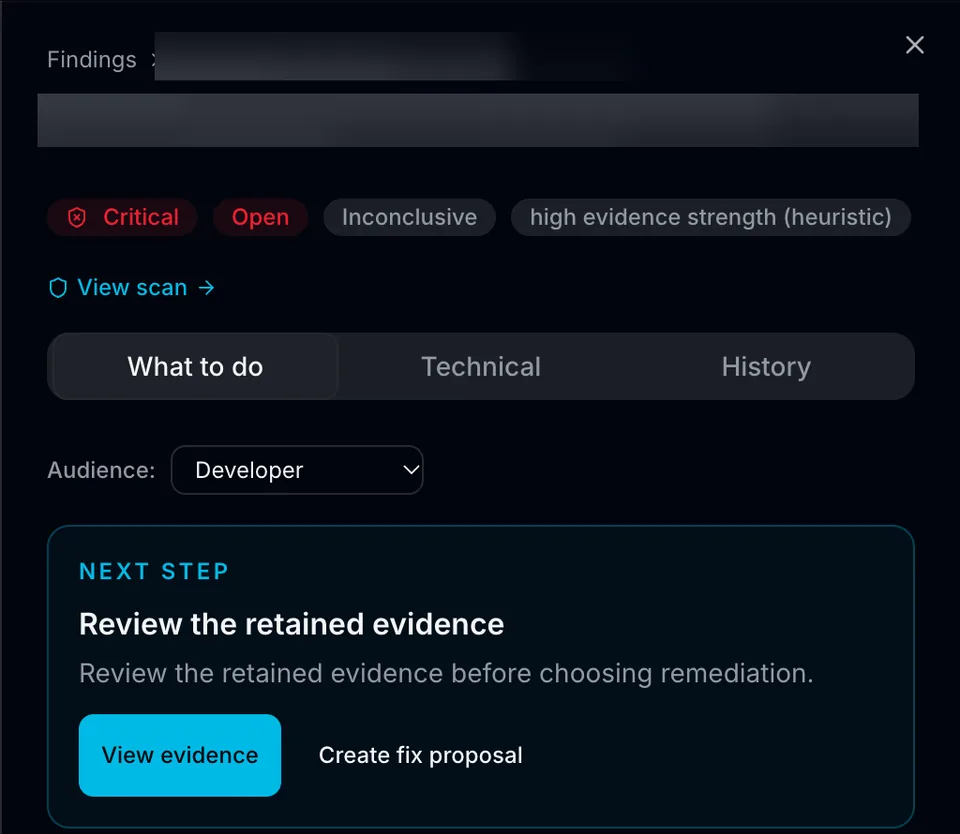
An evidence state records how strongly a security finding is supported. Three states ship today. Detected means a scanner saw a signal. Retest-confirmed means a server-owned retest found the condition absent after a fix. Inconclusive means the evidence cannot establish the condition is gone. A fourth state, independently verified, is defined for a future separate verification step and no finding is in it today. These are never blended into a single score.
TL;DR
Every finding carries one of three shipped evidence states: detected (a scanner signal that needs review), retest-confirmed (a deterministic retest found the condition absent) or inconclusive (the retained evidence cannot establish resolution). A fourth state, independently verified, is defined for a future separate verification step; no finding is in it today. A score or clean result never overrides these facts.
Last reviewed: · Maintained by LyraShield Security + Engineering
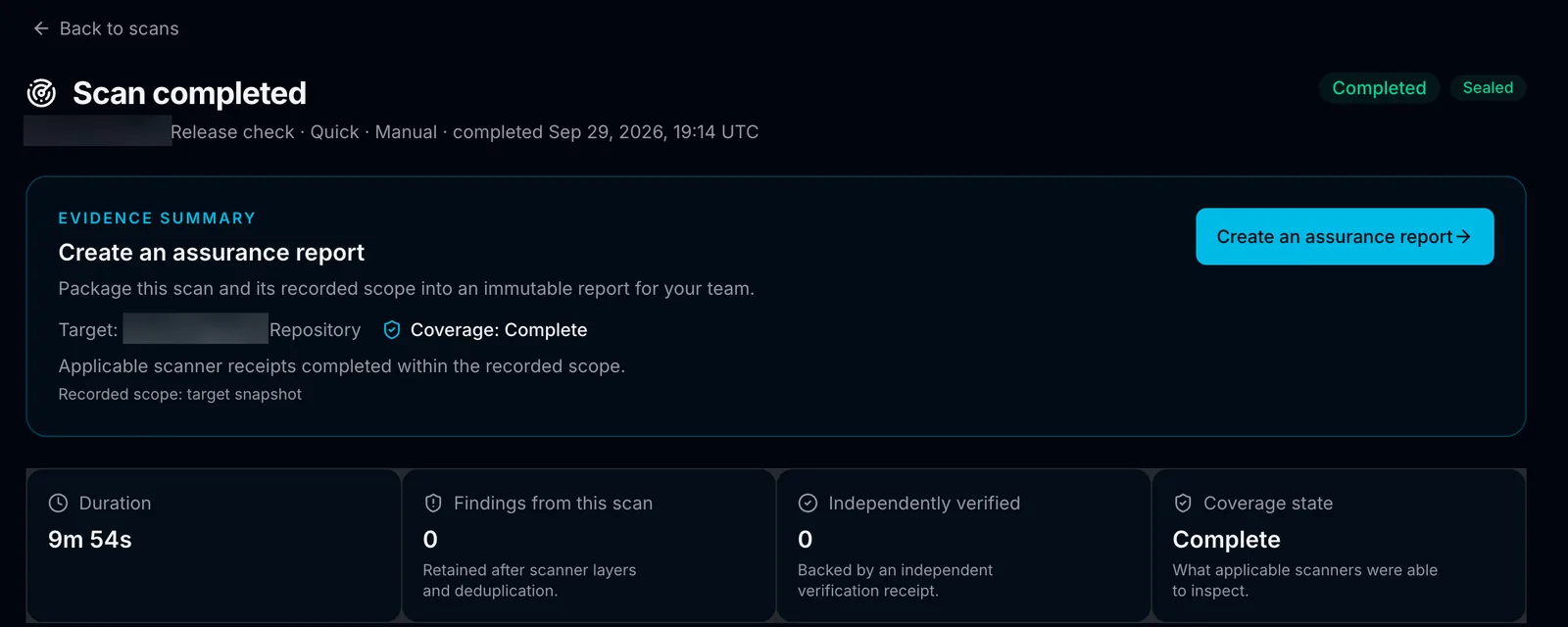
A scanner found a signal worth reviewing. Confidence can help prioritize it, but does not prove exploitability.
Defined for a future separate verification step: a separate receipt would have to support the finding. No shipped path produces this state today, so no finding is in it. Engine confidence alone never creates it.
A server-owned deterministic retest found the relevant condition absent after a fix, with complete applicable coverage.
The available retest evidence cannot establish that the condition is gone. The uncertainty remains visible.
A public scorecard may include a release verdict. The verdict is derived from the frozen LyraShield Score using the same versioned model that produced the grade. It is an interpretation aid, not an override of the underlying evidence.
Coverage records what happened to each check, which is a separate question from what a finding is. A verdict is only as strong as the coverage behind it.
| Coverage state | What it means | Effect on the verdict |
|---|---|---|
| Completed | The check ran against the authorized scope and returned a result. | Counts toward the verdict. |
| Limited | The check ran but could not see everything in its scope. | Counts, with the limitation retained on the record. |
| Skipped | The check did not run, for example because a prerequisite was absent. | Surfaces as insufficient evidence rather than a pass. |
| Not applicable | The control does not apply to the scanned target type. | Excluded from the denominator and stated as such. |
Read the result in this order: confirm the authorized target and mode, inspect completed and limited coverage, separate detected findings from retest-confirmed ones, then read the retest receipt and retained limitations. A LyraShield score or confidence value never replaces the underlying scope, coverage, evidence-state and retest facts.
For a broader catalog of web application verification requirements, consult the OWASP Application Security Verification Standard. This reference does not imply certification or full ASVS coverage.
LyraShield AI does not claim "SOC 2 compliant," "certified," "guarantees security," "AI safety tested" (without a named framework) or "adversarial robustness proven." Each of those requires external attestation, a reproducible evaluation corpus, a defined threat model or a formal certificate that LyraShield has not yet obtained.
An evidence state describes how much support a finding has. Detected, retest-confirmed and inconclusive are the three shipped states. They are not interchangeable labels. A fourth state, independently verified, is defined for a future separate verification step; no finding is in it today.
No. A score is an interpretation aid derived from the evidence. It does not override the underlying findings, coverage limits or retest receipts.
It means the assigned check completed without reporting anything in scope. It is not the same as 'passed' or 'secure'; it only records that the check ran and returned nothing.
It is a fixed list of 50 controls LyraShield AI reviews on AI-built apps. 43 are routed to code or URL review where applicable and 7 require operational or human evidence outside the scan because a repository or URL scan cannot establish them safely.
The free tools run locally in your browser and state their limits.
LyraShield support
Myra · AI support
I'm Myra, LyraShield's AI support agent. I can explain the product, help with setup or connect you with a person.
I’ll use LyraShield guidance where I have it and help you reach support when I don’t.