
SonarQube vs LyraShield
How LyraShield AI release assurance compares to SonarQube static analysis, quality gates, and AI code verification for AI-built apps.
On this page
SonarQube is an established static analysis platform covering code quality and security across more than 40 languages, with quality gates, taint analysis, secrets detection, and AI-powered fix suggestions used by over 7 million developers. LyraShield AI is release assurance for AI-built apps: it pairs an agentic pentest with SCA and secrets, separates detection from proof, and produces an immutable evidence record with approval-gated fixes. SonarQube excels at continuous code quality and SAST; LyraShield closes the proof and release-decision gap.
This comparison is part of our broader vibe coding security guide, which covers the full release-assurance methodology for AI-built applications.
What SonarQube does well
SonarQube from Sonar is the industry-standard static analysis platform, trusted for over 17-plus years and used by 75 percent of the Fortune 100. It analyzes more than 40 programming languages and frameworks with over 7,000 rules, detecting bugs, security vulnerabilities, code smells, duplications, and maintainability issues. Its SAST engine covers the OWASP Top 10 and beyond, with taint analysis for Java, C#, JavaScript, and TypeScript that traces data flows deep into third-party libraries.
The standout feature is the Quality Gate, a go or no-go check that fails a pipeline when code does not meet defined standards. This integrates natively with GitHub, GitLab, Azure DevOps, and Bitbucket, decorating pull requests with actionable issue summaries and enforcing go or no-go release criteria. SonarQube also offers AI CodeFix, which uses large language models to suggest one-click fixes for detected issues directly in the IDE, accelerating remediation for both developer-written and AI-generated code.
SonarQube has framed itself as an independent verification layer for AI-generated code, arguing that using the same tool to generate and verify code produces poor results. It detects issues AI models introduce, such as hardcoded secrets, injection flaws, weak cryptography, resource leaks, null pointer exceptions, and race conditions. A free Community Build and the SonarLint IDE extension lower the barrier to entry, and the platform supports compliance standards including NIST SSDF, CWE, STIG, and CASA. SonarQube also offers an MCP Server that connects its analysis engine to AI coding agents and custom pipelines, bringing static analysis into agent workflows.
SonarQube’s quality gate is one of the most operationally useful features in static analysis. A pipeline that fails when code does not meet defined standards turns analysis from a report into an enforcement mechanism, which is why so many enterprises have standardized on it. The portfolio and application dashboards, plus compliance reporting mapped to standards like NIST SSDF, CWE, STIG, and CASA, make it straightforward to demonstrate code health to stakeholders and auditors. The MCP Server is a meaningful addition because it lets AI coding agents query the same analysis engine programmatically.
Where LyraShield’s release assurance approach differs
LyraShield AI agrees with SonarQube’s core insight: independent verification matters for AI-built code. Where they differ is what verification means. SonarQube verifies code quality and known vulnerability patterns through static analysis. LyraShield verifies release safety through an agentic pentest that exercises findings against the live target.
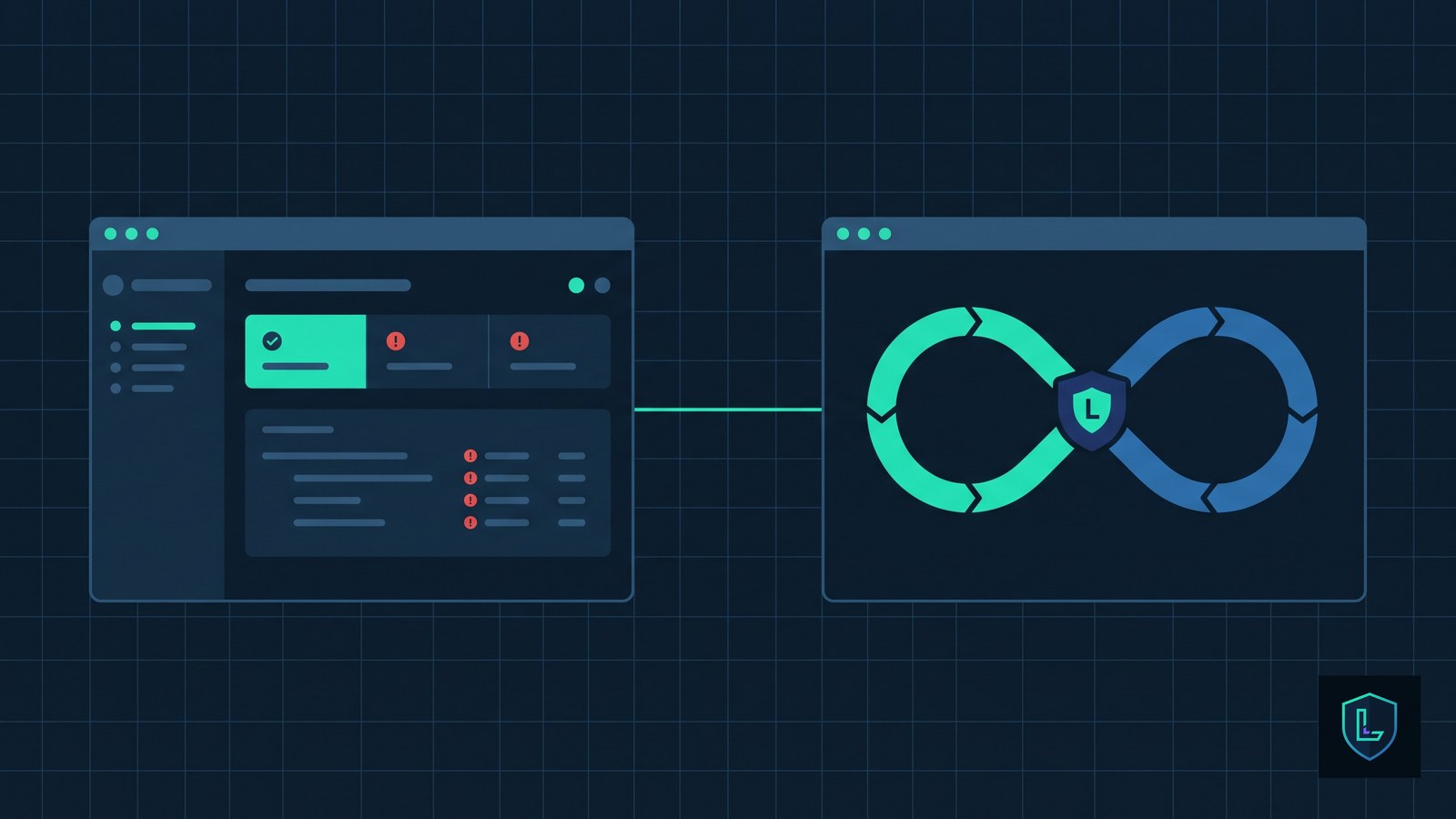
The LyraShield loop is target, review, evidence, fix, retest, report. A SAST finding, however precise, is a prediction about the code. The agentic pentest tests that prediction against the running app and records the result as an evidence state: detected, proven, or fixed and retested. That immutable record is the release artifact, not a quality gate. A quality gate tells you the code meets a standard; an evidence state tells you whether a specific finding was proven exploitable and whether the fix was verified.
LyraShield runs inside AI coding agents through the Model Context Protocol, the same protocol SonarQube’s MCP Server uses to reach agents. The difference is that LyraShield’s checks are part of a release-assurance loop with approval-gated fixes, not continuous quality analysis. Fix proposals require a developer’s approval before merging, and a mandatory retest closes each finding. This is a stronger constraint than a suggestion or a one-click fix.
For dependency risk, LyraShield uses SCA backed by sources like the OSV database. SonarQube does not currently provide deep SCA as a primary capability, so the two complement each other on supply-chain coverage. LyraShield emits SARIF so results can flow into existing tooling alongside SonarQube’s findings.
The difference between a quality gate and an evidence state is worth stating precisely. A quality gate is a binary pipeline check: the code either meets the configured standards or it does not, and the pipeline fails or passes accordingly. An evidence state is a per-finding record of what was proven about the running app and what was done about it. The quality gate answers is this code clean; the evidence state answers is this app safe to release. Both are legitimate, and they serve different moments in the lifecycle.
Who each tool fits
Use SonarQube when you want continuous code quality and security analysis with enforceable quality gates across a broad, polyglot codebase. It is the right choice for teams that need maintainability, duplication, and architectural analysis alongside security, and that want a mature, deterministic verification layer with 17-plus years of rule development behind it. The Community Build and SonarLint make it accessible, and the compliance reporting supports standards like NIST SSDF, CWE, STIG, and CASA.
Use LyraShield AI when the decision is specifically about releasing an AI-built app safely, and you need proof of exploitability plus an immutable record. The tools overlap on security detection but not on primary purpose. A common setup is SonarQube for continuous quality and SAST throughout development, with LyraShield for the assurance run before release.
SonarQube and LyraShield address different moments and produce different artifacts, which is why they coexist well. SonarQube runs continuously and enforces quality across every pull request and build, which is where most code health work happens. LyraShield runs at the release gate and produces the evidence record that supports the ship decision. A team that has SonarQube’s quality gate already in place gets daily value from it, and adds LyraShield when the question shifts from code health to release safety.
| Dimension | SonarQube | LyraShield AI |
|---|---|---|
| Primary goal | Code quality and security verification | Release assurance with proof for AI-built apps |
| Detection model | SAST, taint analysis, secrets, 30-plus languages | Agentic pentest plus SCA plus secrets, evidence states |
| Fix model | AI CodeFix suggestions | Approval-gated fix proposals, retest before close |
| Agent integration | MCP Server, IDE, CI | MCP inside AI coding agents plus GitHub Action |
| Output | Quality gate, dashboards, reports | Immutable assurance record, SARIF |
For the detailed breakdown see the SonarQube comparison page. If your team uses Windsurf, the Windsurf security workflow guide pairs well with either tool.
Why teams choose LyraShield for AI-built apps
Teams choose LyraShield when a quality gate is not the same as a release decision. The agentic pentest proves whether a finding is real against the running app, the immutable evidence record gives reviewers and auditors something concrete, and approval-gated fixes keep a human accountable for every agent-proposed change. For apps where the code came from a coding agent and the team needs to sign off before production, that loop is the difference between a clean quality gate and a defensible release decision.
SonarQube is a proven, broad verification layer with deep language coverage and a long track record. LyraShield does not try to replace it for code quality. The value is the focused loop: target, review, evidence, fix, retest, report. For an app whose code came from a coding agent, that loop is what turns a clean quality gate into a defensible release sign-off backed by proof.
LyraShield is live with open registration. Some platform features remain on the near-term roadmap and are not yet live, so check the current status on the site before relying on a specific capability. Run the AI app security checklist on your project, then sign up at https://lyrashieldai.com to start a release-assurance run.
Frequently asked
Does SonarQube verify AI-generated code?
Yes. SonarQube positions itself as an independent verification layer for AI-generated and human-written code, detecting bugs, vulnerabilities, code smells, and secrets. It applies deterministic static analysis. It does not, however, run a live agentic pentest or produce an immutable release-assurance record.
Is LyraShield a code quality tool?
No. LyraShield focuses on security release assurance for AI-built apps: an agentic pentest, SCA, secrets, evidence states, and approval-gated fixes. It does not replace SonarQube for code quality, maintainability, duplication, or architectural analysis.
Do SonarQube and LyraShield overlap?
They overlap on security detection but solve different problems. SonarQube provides continuous static analysis and quality gates across 30-plus languages. LyraShield provides a focused release-assurance loop with proof of exploitability and an immutable evidence record. Many teams use both.
Does SonarQube have an MCP server?
Yes. SonarQube offers an MCP Server that connects its analysis engine to AI coding agents and custom pipelines. LyraShield also runs inside AI coding agents through the Model Context Protocol. Both can integrate with agent workflows, though with different goals.
Related posts
- Aider App Security Checklist for AI Pair Programming
A security checklist for reviewing apps built with Aider covering MCP server config, secrets, dependencies, and verifiable evidence with LyraShield AI.
- Using LyraShield AI Alongside Aider for Secure AI Coding
How to run LyraShield security checks alongside Aider today using the CLI and GitHub Action diff gate. Native MCP is a roadmap item Aider has not yet shipped.
- Aikido vs LyraShield for AI Built App Security
Aikido unifies SAST SCA secrets and cloud scanning from code to runtime; LyraShield wraps AI app testing in a release assurance loop with approval gated fixes.